Chapter 3
Consistent Trades,
Strong Impact.
Driven by a drive to build an algorithm that actually works and delivers on all its promises, this guide is where all bold traders willing to take a chance take their first step. Let’s grow together into something meaningful and get your started on your path towards consistent profitability.
The Data That Tells a Story
Every trade that you take builds a story. This story is what makes up your trading journey. Visualizing your story will help guide smart decisions. Because they help reveal treands and uncover important insights, charting your path to success is perhaps the most important aspect in your trading journey.
It All Starts With You
When you put effort, stick to the strategy, get your education, and reinvest your gains, you can only go up.

Chapter 1. Dragon Trades
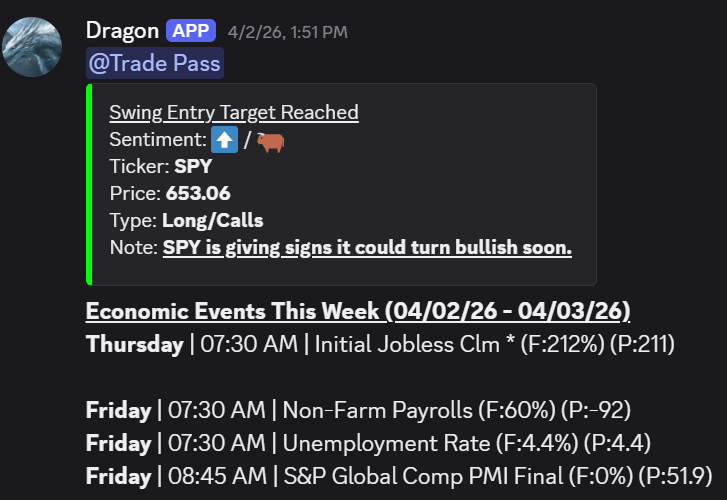
What is the Dragon Bot?
Dragon bot is an algorith that signals entries on long positions for ETF SPY in particular. The algorithm is the result of years of work, encompassing over 20 different unique indicators. Dragon wasn’t purposely built to be what it is, but rather, it’s the result of many alterations to the algorithm over the years. This product is the end result of over 3 years worth of work. It doesn’t just follow trends; rather, it’s optimization was built so that it would signal at the most pivotal points. It uses both live data and historical ones to make high quality predictions.
Dragon bot was built with a very simple intention: to give every single trader that uses it an edge in the market. Time and again, retail traders are exposed to unreliable algorithms that don’t yield the results promised. With Dragon bot, we here at S&T tasked ourselves with changing the game to your favor. This algorithm is of the highest quality, and if you trade it correctly with the strategy we will discuss below, your ability to yield profits will give you the consistency you have long been waiting for.
How do we trade it?
Trading Dragon Bot signals is incredibly easy. The strategy to maximize profitability while reducing risk has long evolved over the years, now perfected just for you. Dragon Bot signals require you to open up a position using a Vertical Bull Call Spread. This specific structure is designed to align with Dragon’s high win rate while protecting your capital from market volatility.
The logic behind the 5DTE $1-Wide Vertical OTM strategy is rooted in structural efficiency and risk mitigation. When the Dragon Bot signals an entry, the goal is to capture a specific directional move while neutralizing the factors, like time decay and high volatility, that typically work against retail traders. By choosing a 5-day expiration (5DTE), you provide the trade with a necessary "duration buffer." This ensures that if the predicted $2.00 move in SPY takes several days to materialize rather than happening instantly, the position remains healthy and avoids the rapid "theta burn" associated with shorter-term, naked contracts.
The core of this strategy lies in the $5-wide strike selection. By simultaneously buying a call near the current price and selling a call exactly $1.00 higher, you create a "vertical" spread that drastically lowers your cost of entry. Selling that higher strike acts as a direct rebate on your purchase, often reducing your total capital at risk by as much as 70%. This isn't just about saving money; it’s about mathematically improving your recovery rate. Because your max risk is so much lower, you no longer need a massive string of wins to recover from a single loss, allowing the Dragon Bot's high signal accuracy to actually compound your account balance over time.
Furthermore, this setup turns Time Decay (Theta) from an enemy into a secondary profit driver. In a standard naked call, every hour the stock stays flat, you lose money. In this vertical spread, the call you sold is also losing value, which hedges your position. As the stock approaches your $2.00 profit target, the "short" leg of your spread often decays faster than the "long" leg, essentially "squeezing" extra profit out of the trade the longer it stays open within your 5-day window.
To execute this effectively, the process must remain mechanical. Once the Dragon Bot issues a signal, you open the position as a Debit Vertical and immediately identify your exit price. Because this is a hedged strategy, you are not swinging for the fences on a single "lottery ticket" move; instead, you are playing a high-probability math game. You simply wait for the $2.00 move, at which point the difference in "Delta" between your two strikes will have inflated the value of the spread, allowing you to "Sell to Close" and capture a consistent, professional-grade return.
Quick Points to Remember
Things to keep in mind:
Wait for the Signal: Do not front-run the Bot. Wait for the official Dragon entry. Once it signals, you can go ahead and open the trade.
Open the Vertical: Enter your 5DTE $1-wide spread as a "Debit" transaction. Do not make the spread $3 or $7 unless you have a very wide range of experience trading these signals and options in general.
Set the Exit: Once SPY moves $2.00 from your entry point, "Sell to Close" the entire spread to capture your profit. It doesn’t matter if you think it will move higher. Remember, your profits are capped in this particular strategy and ensuring profitability is key. Keep in mind that the strategy has been tracked and charted for years and your results can only match the ones advertised if you follow the strategy.
EXAMPLE OF HOW TO TRADE DRAGON BOT
Take a look at the following example. Let’s assume the following was the price of ETF SPY when Dragon bot signaled.
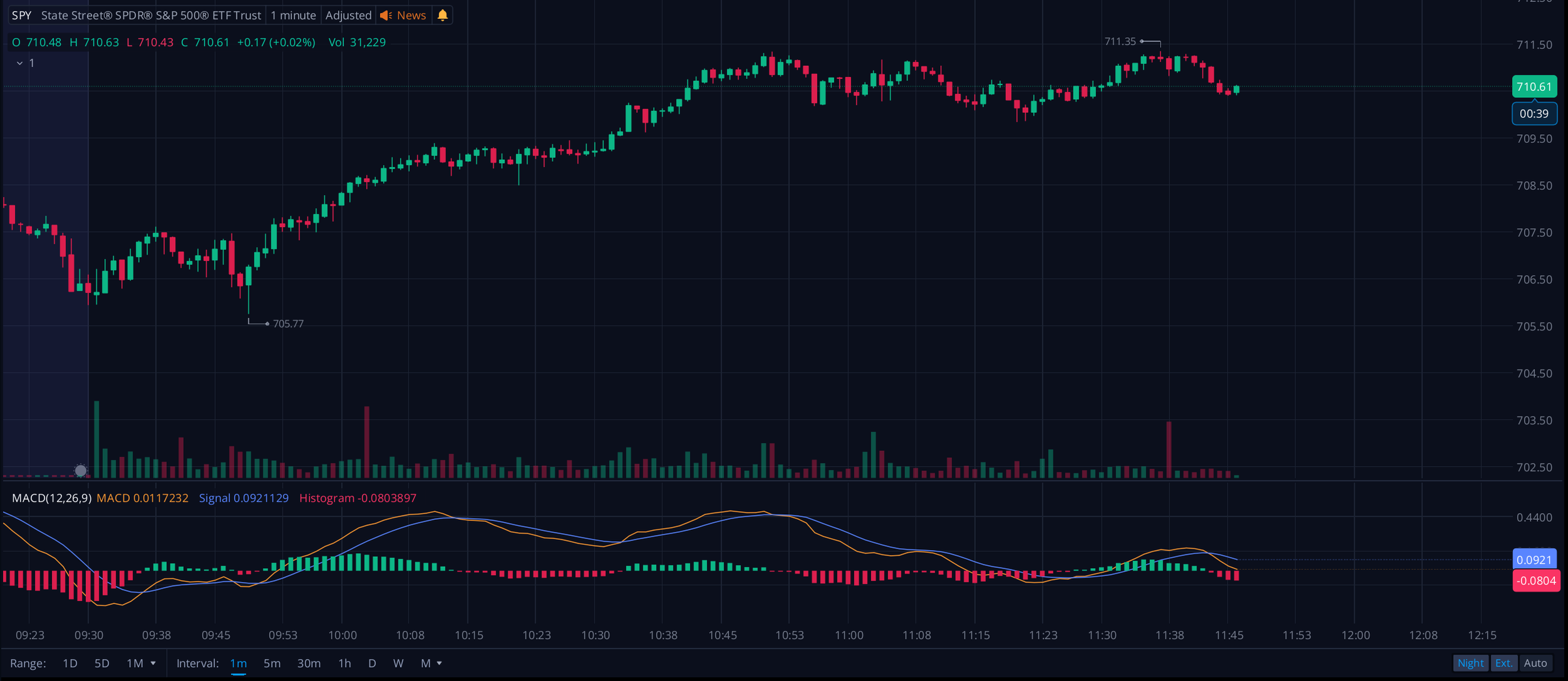
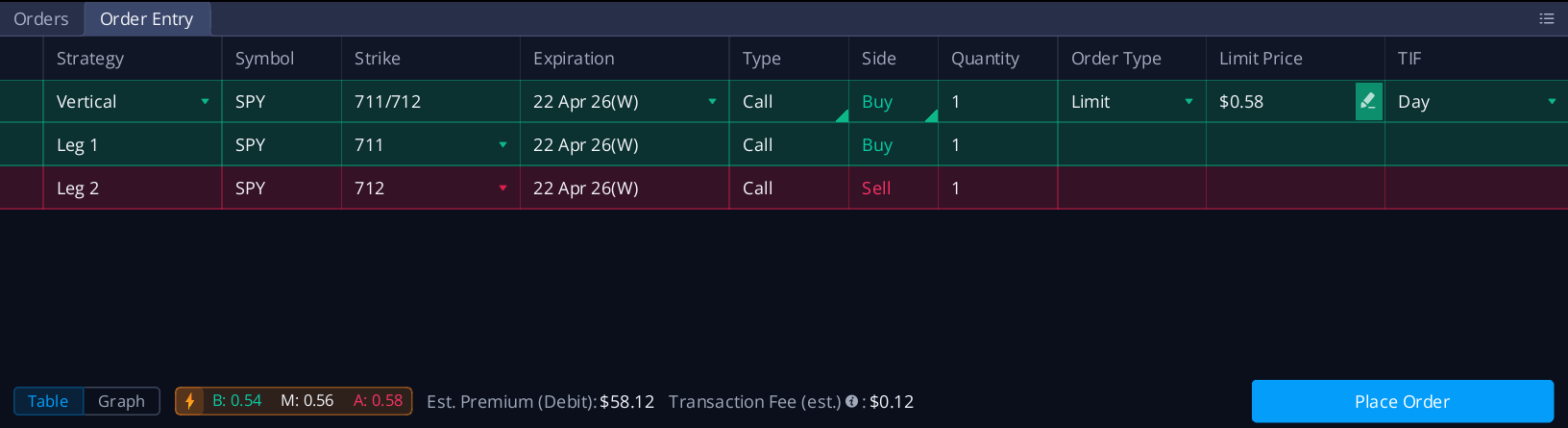
The first thing we do is pick the expiration date. 5DTE. Then, we pick a vertical spread strategy with the intention of buying ATM or the nearest strike on options for that. In this case, that falls on $687. At the same time, we will be writing calls $1 above that. Remember, always keep your spread $1 wide. In the example below, Webull sometimes does not show the combined premium since at the time of me making this guide, the market is closed. Because the markets are currently closed or the "bid-ask spread" is temporarily too wide to calculate a single stable "Mid" price. However, we can easily predict what the price of these contracts were trading at. Based on the current SPY price of $710.61, here is where your premium is likely to settle:
Estimated Net Debit:$58.12 per contract.
That is your maximum risk in this trade, unless you decide to open more contracts per trade.
When most trades close the same day the algorithm signals, the yield is typically lower—around 17% to 25%—because the position hasn't had time to benefit from Delta acceleration or Theta decay. On Day 0, your profit is driven purely by the stock's price movement. Because you are using a vertical spread, the short leg (the call you sold) gains value almost as fast as your long leg (the call you bought) when the stock moves up. This creates a drag on your immediate P&L, capping your quick gains in exchange for the safety of the hedge. You are effectively capturing the small difference in delta between the two strikes, which results in a consistent but smaller initial payday.
Conversely, the longer the trade takes to reach its target, the more profitable it becomes due to the accelerating effect of Time Decay (Theta). As the days pass, the short call you sold loses its extrinsic value or hope much faster than your "Long" call. This decay acts as a daily credit to your account. If the stock reaches your target on Day 7 or Day 10 instead of Day 1, you aren't just getting paid for the price move; you are also "keeping" the premium from the 695 Call that is slowly expiring worthless. This "Theta crossover" is why a trade that yields $46 today might yield $120 next week at the exact same stock price.
Generally speaking, for a $1-wide spread entered at a debit of $50-$60, you are looking at specific price windows for profit and loss. You can expect to close at a profit if the spread value expands toward the 20% range, which typically happens when SPY moves +$2.00 or holds its ground over several days. On the other hand, you would generally be looking at a loss if the spread value drops below the strike of the call you bought, which occurs if SPY moves against you by more than $1.50 or remains completely stagnant for the first few days while the long leg loses value faster than the short leg. Your ultimate goal is to exit when the market is willing to buy back your spread for more than the $50-$60 you paid to open it.
In simpler words…
Think of this strategy as a protected profit window. When you close a trade on the very first day, you are essentially getting a fast-move bonus. Because you are selling one call to pay for another, your profit is capped early on. You’ll likely see about a 20% gain ($11–$15 profit on average per contract) because the two options are still fighting each other; the one you sold is gaining value almost as fast as the one you bought. You're taking a smaller, quicker paycheck in exchange for the safety of having a hedge in place.
However, the magic of this trade happens if the stock takes its time. The longer you hold (closer to that 5-day mark), the more the Time Decay works in your favor. The option you sold to the market starts losing its value every single day. You are essentially "collecting rent" on that contract. This is why the same price move can pay you $20 on Day 1, but $60 on Day 5; you're getting paid for the price move plus all the time that has passed.
The Price Cheat Sheet
To keep it simple, here is what those numbers look like in your account:
To Make a Profit: You want to see the value of your spread rise from your entry price (around $58 in the example above) toward $3.00 or higher. If SPY moves up just $2.00, the market will usually offer to buy your spread back for a profit.
To Hit a Loss: If SPY drops significantly or just sits completely still for a week, the value of your spread might dip.
By using this method, you aren't just betting on the stock going up; you are setting up a trap where you get paid more the longer the stock stays in your "Profit Zone." It turns "waiting" from a frustration into a paycheck.
Key Takeaways:
The "Patience Paycheck": Notice how the profit jumps significantly between Day 1 and Day 5. This is because the option you sold is losing its value (decaying) much faster as it gets closer to expiring.
Day 0 vs Day 5: You are making more than double the profit on Day 5 for the exact same stock price move.
*The Day 5 Risk: On the very last day, "Variable" means your profit depends entirely on whether the stock is above your breakeven. If it's below $710, the profit drops to zero instantly. This is why we usually take the win before the final day.
If by day 5 the trade is still open(we haven’t crossed the $2 mark), it’s ideal to just close it and take the loss. In fact, lets talk about how to set a structured loss on these trades. You can elect to set up a strict 60% stop loss. After backtesting this algorithm and strategy, the goldilock zone to close the trade at a loss is 60%, because the chances of it bouncing back up into profit are almost zero. A 60% stop loss gives the trade plenty of breathing room to move. By having a strict stop loss, you cap the maximum amount of money you can lose on this.
Some thing great about this algorithm is that many times, the price of SPY opens $3-$5 above entry the next day. A move like that can instantly yield anywhere between 35%-60%. You will find yourself holding a lot of trades overnight that open at very big profits, far above your average. Remember, theta is working for you when the price of SPY is above $2 of the price of SPY when you opened the position.
Example
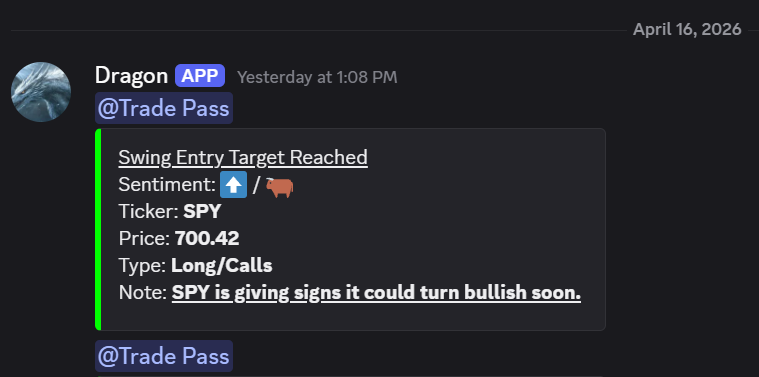
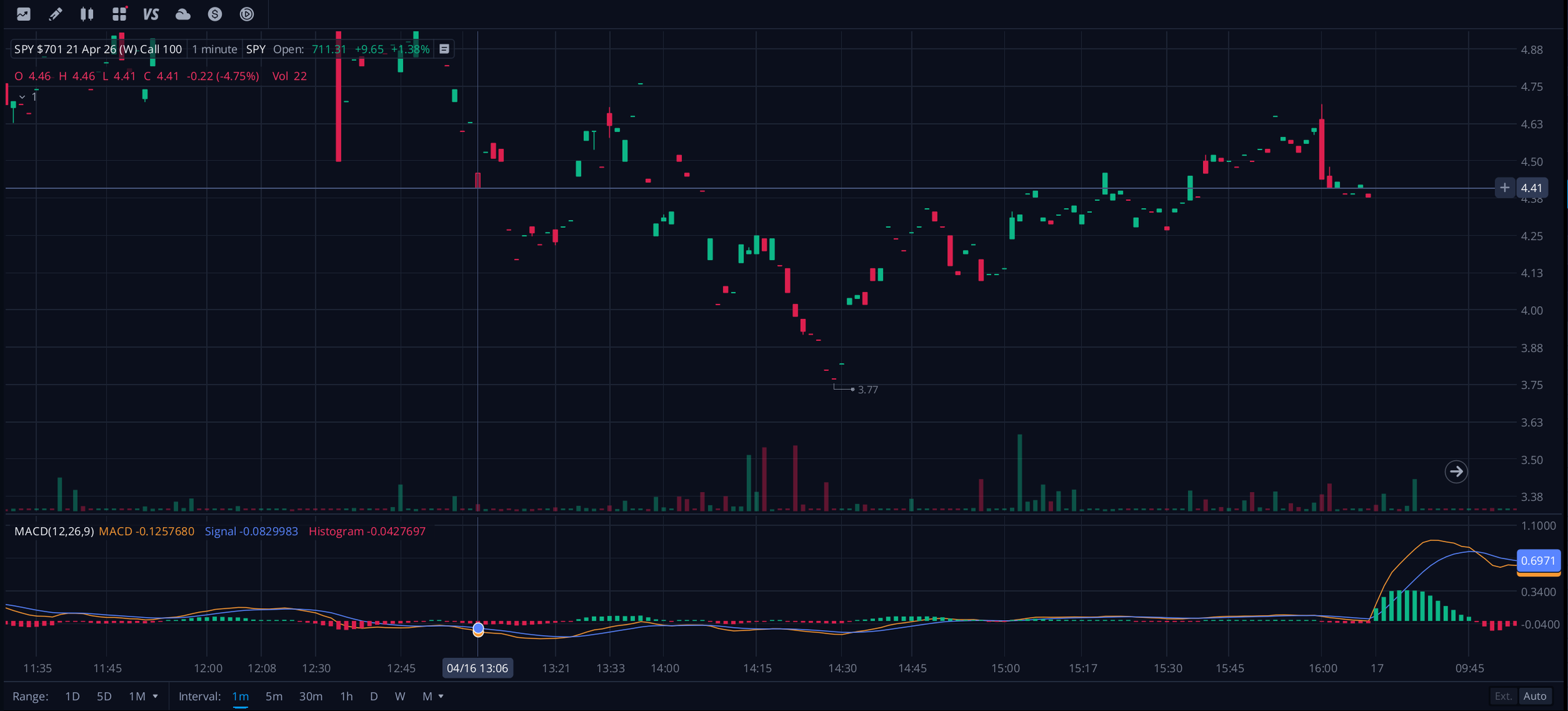
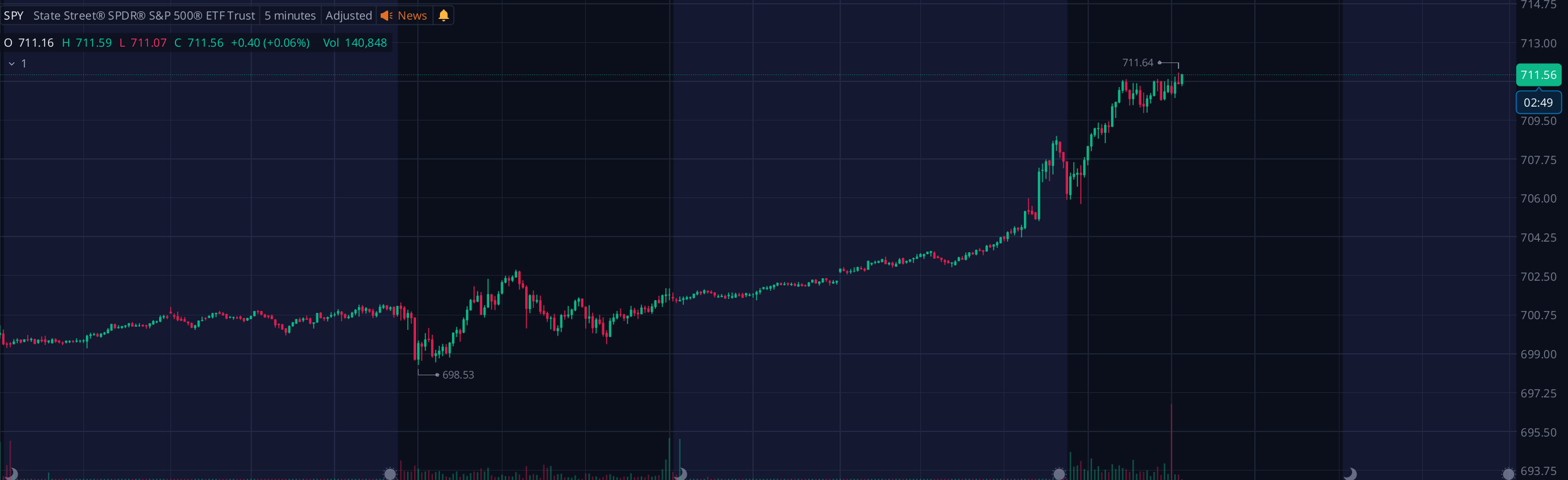
We are going to examine how this entire trade went. As you can see, the algorithm signaled to buy calls when SPY traded at $700.42. As you know, the first thing we are buying is 5DTE calls. The date of that signal was April 16th which means the call has to be April 21st. We will be buying $1 spreads OTM, which means we buy calls $1 above the price of the price of SPY, so a strike of $701 in this case while simultaniously writing a call at $702, making it a $1 spread since the call we are buying and selling are 1 dollar apart.
The $701 calls traded at $4.41, as yopu can see below.
$702 calls, the ones you are writing, traded at $3.90.
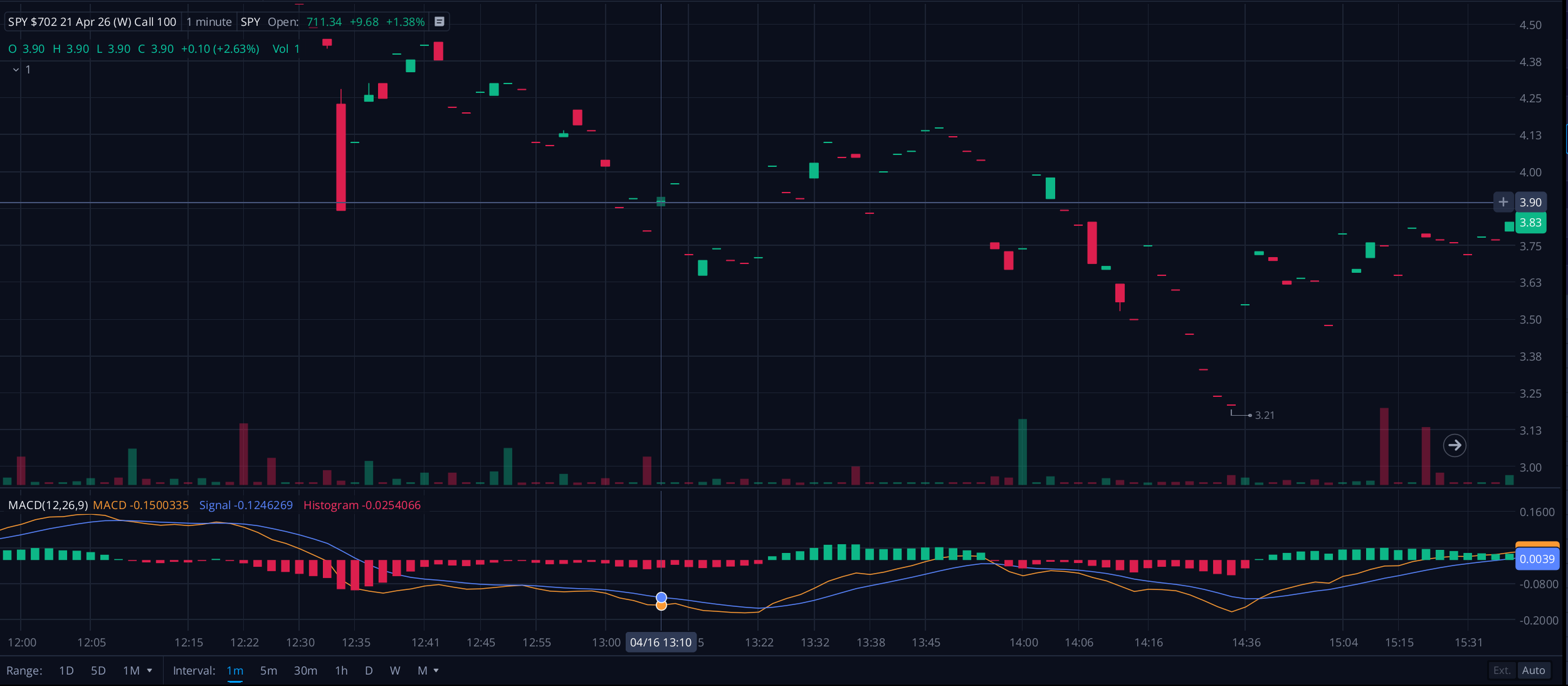
The debit premium was $0.51(or $51.00 per contract).
NetDebit = Long Call Price - Short Call Price
$0.51 = 4.41 - 3.90$
Since one standard options contract represents 100 shares, the total cash outlay is $51.00.
The next day, SPY opened up like $10 up from the price it closed the previous day when we opened the position. The $701 calls traded at $7.19 at open while the $702 calls traded at $6.00. This means my gain was 133% overnight. Let me show you the math:
I opened a bull call spread by:
Buying $701 call at $4.41
Selling $702 call at $3.90
Step 1: Initial cost (debit)
Net debit = 4.41 − 3.90 = $0.51 per spread
Since options are ×100:
→ $51 cost per spread
Step 2: Value at next day open
$701 call = $7.19
$702 call = $6.00
Spread value = 7.19 − 6.00 = $1.19
→ $119 per spread
Step 3: Profit
Profit = 1.19 − 0.51 = $0.68 per share
→ $68 profit per spread
Step 4: Percentage return
Return = 68 / 51 ≈ 133% gain
Final Answer
Dollar gain: $68 per spread
Percentage gain: ~133%
How accurate is Dragon bot?
Dragon bot is the most profitable algorithm available to retail traders in the world. With an accuracy over 99% when you employ the trading strategy recommended in this guide, your chances of netting a profit are so high that not taking a trade on the Dragon signals actually works to your detriment. At S&T, we strongly believe in being as transparent as possible, so we have made it available for everyone to look at all previous signals by the Dragon bot since inception.
First and foremost, the esiest way to check up on all signals is via the following link. This Sheets link will give you access to a log that details information on the date and specific price of SPY when Dragon signaled, and the date the trades closed. The other way to access this information is via our Discord server where the actual trades go out.
How do we get these alerts?
Dragon bot trading signals are exclusively reserved for Trade Pass members via our Discord. If you are interested and it’s your first time trading these, I would be more than happy to give you a very fair discount and even let you in for free for a week so you can see for yourself the results. Contact me via the form below or via Discord itself by tagging me at @simulateandtrade.